
Pickleball keeps adding players faster than any other racket sport in North America, and the equipment side of the business is consolidating around buyers who understand what is actually inside a paddle. For brand owners, sporting goods distributors, and private label sellers, material selection is no longer a technical footnote — it is the main lever behind price positioning, durability claims, warranty rates, and ultimately margin.
This guide breaks down the materials and construction methods that matter in 2026, from the perspective of a factory floor rather than a marketing brochure.
Why Material Choice Defines Your Positioning
Walk into any sporting goods retailer and you will find pickleball paddles ranging from $40 house brands to $250 professional models. The visible differences — graphics, grip, shape — explain very little of that spread. Nearly all of it comes down to three decisions: the core material, the face material, and the construction process.
For B2B buyers, these three decisions determine:
- Retail price band you can defend in the market
- Durability and warranty exposure — core crush, face delamination, and edge guard failures drive most returns
- Performance story — power, control, and spin claims that have to survive independent reviews
- Compliance with USAPA/USA Pickleball testing for sanctioned play
Core Materials: The Heart of the Paddle
Polymer Honeycomb (PP Core)
Polypropylene honeycomb remains the industry standard, and for good reason. It offers the best balance of power, control, sound, and cost. Cores are specified by cell size and density — typically 8mm or 10mm cells — and thickness runs from 10mm (control-oriented) to 16mm (power and softer feel).
- Best for: mid-range and premium programs, all-around play
- Watch out for: core density inconsistencies from low-grade suppliers, which show up months later as dead spots and warranty claims
Nomex and Aluminum Cores
Nomex (aramid paper honeycomb) delivers a harder, louder, more powerful response and is cheaper to produce, which is why it still appears in entry-level and power-focused paddles. Aluminum cores sit in between, with a softer feel than Nomex but less durability than polymer.
For most B2B programs in 2026, polymer has won the middle and premium segments; Nomex survives mainly at the value end where price is the only message.
Face Materials: Fiberglass vs. Carbon Fiber
Fiberglass
Fiberglass faces are flexible and forgiving, producing a trampoline effect that adds power on off-center hits. They are also cheaper and easier to print, which suits colorful graphics-led programs.
Carbon Fiber — Woven and Raw
Carbon fiber faces stiffen the hitting surface, enlarge the effective sweet spot, and give players the control and spin that competitive play demands. The market has shifted decisively toward raw carbon fiber (T700) surfaces since raw carbon’s natural texture generates dramatically more spin than painted or coated finishes.
Two grades dominate sourcing conversations:
- T300 carbon — a solid mid-tier choice, good control characteristics, moderate cost
- T700 raw carbon — the current premium standard, best spin numbers, highest perceived value
A practical hybrid also exists: carbon-fiberglass blends, which split the difference on both price and performance and work well for private label programs targeting recreational-to-intermediate players.
Construction: Cold Pressed vs. Thermoformed
Construction method is where the biggest performance gap opened up over the last two years.
Cold pressing glues core and faces together at room temperature. It is a mature, low-tooling-cost process — fine for entry-level programs, but the adhesive layer is the weak point under sustained play, and edges rely on added guard strips for protection.
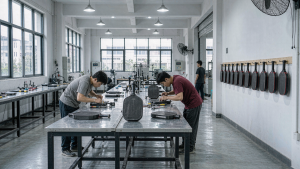
Thermoforming bonds the assembly under heat and pressure, with carbon and foam injected around the perimeter and handle. The result is a unibody-style structure: better twist resistance, a longer-lasting sweet spot, and the extended handle-to-face grip that performance players now expect. It requires more expensive tooling — which is exactly why it separates serious manufacturers from assembly shops.
For any brand positioning above the $100 retail mark in 2026, thermoformed construction has effectively become table stakes.
What B2B Buyers Should Verify Before Committing
Material specs on a quotation sheet are easy to write and hard to audit. Before committing to a production program, we recommend buyers verify:
- Sample-to-production consistency — approve a sample, then test units from the actual mass production batch, not the sample room
- Core density and cell uniformity — request cut-away samples or factory QC reports, not just spec claims
- USAPA compliance documentation — if paddles will be marketed for sanctioned play
- Batch-level testing records — face peel strength, handle twist, and drop tests
- Tooling ownership — who owns the molds, and what happens if you switch factories
Matching Materials to Your Channel
A material stack that works for an Amazon private label launch is different from one built for club pro shops:
- E-commerce private label: T700 raw carbon face with a 16mm polymer core, thermoformed — the current bestseller profile, supported by fast sampling and flexible MOQ
- Retail distribution: blended or fiberglass faces at value price points, cold pressed, with graphic variety to fill shelf space
- Clubs and training academies: durability-first specs — polymer core with reinforced edge guards — since rental and program paddles live hard lives
Our custom pickleball paddle program covers all of these profiles with OEM branding, from paddle shape and core specs to face printing and packaging, with a 50-piece MOQ for brands, clubs, and rental programs.
The Bottom Line
The 2026 market rewards specificity. Buyers who can articulate exactly what is in their paddle — core density, carbon grade, construction method — negotiate better, market better, and carry lower warranty risk than those buying a generic “carbon paddle” from a trading company. Ask your supplier the hard material questions early; a factory with real in-house capability will welcome them.
Ready to spec your program? Request a quote and our engineering team will respond within 24 hours with material recommendations matched to your channel and price point.