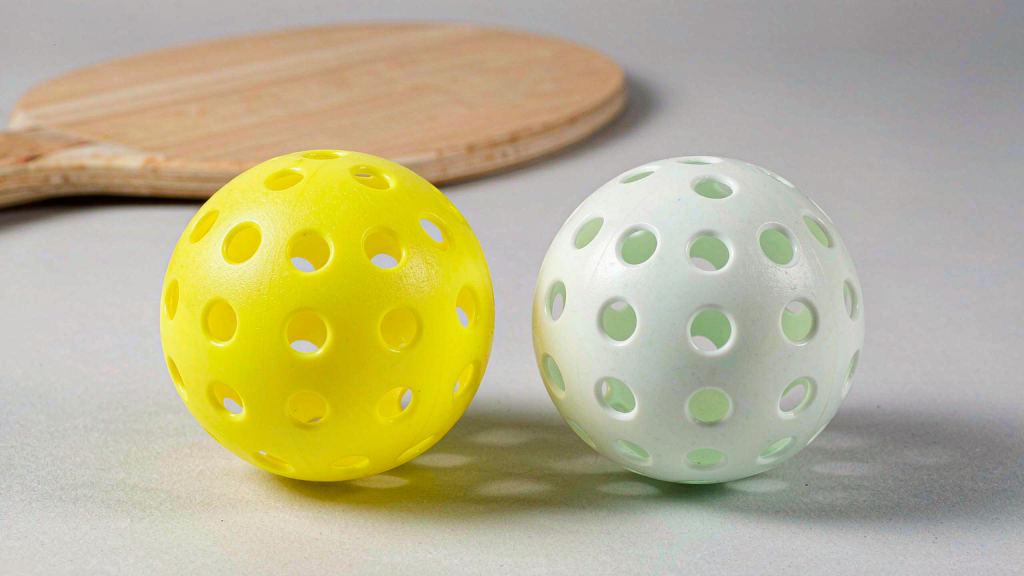
The 40-hole rotomolded pickleball is the softer, quieter, wind-stable workhorse — benchmarked against the Franklin X-40 — while the 48-hole injection-molded ball is the harder, faster, precision-flight option benchmarked against the LFtime Pro. The difference comes from two things: hole pattern and manufacturing process. We produce both in our factory, so this guide explains what actually separates them on the court, in players’ hands, and on your order sheet.
Quick Comparison: 48-Hole vs 40-Hole Pickleball Balls
| Feature | 40-Hole Ball (Rotomolded) | 48-Hole Ball (Injection Molded) |
|---|---|---|
| Manufacturing process | Rotational molding (seamless one-piece) | Injection molding (precision mold) |
| Benchmark model | Franklin X-40 class | LFtime Pro class |
| Feel off the paddle | Softer, slightly muted pop | Harder, crisp, lively pop |
| Flight | Stable in wind, controlled pace | Tighter trajectory, faster and truer |
| Bounce | Consistent, slightly higher dwell | Very uniform, quick rebound |
| Noise level | Quieter | Louder, sharper contact sound |
| Weather behavior | Holds flexibility in cold weather | Most consistent in warm conditions |
| Best channel | Outdoor clubs, school programs, volume retail | Premium retail, tournament and club match play |
The 40-Hole Rotomolded Ball: The Reliable Workhorse
Rotational molding produces a seamless one-piece ball. Molten PP resin coats the inside of the mold as it rotates, so there are no seams to split and no weld lines — the reason this construction dominates outdoor club play worldwide. Our 40-hole ball is engineered to the same performance envelope as the Franklin X-40: 40 mixed-size holes that drag the flight just enough to keep the ball on line when the wind picks up, a softer impact feel, and a lower, friendlier sound profile.
Where it wins:
- Wind stability — the defining trait of a good outdoor 40-hole ball; rallies stay honest on open courts
- Crack resistance — the rotomolded shell flexes instead of shattering, especially in cool morning play
- Softer, quieter feel — easier on the elbow and on the neighbors, which matters for community courts and HOA communities
- Volume economics — rotomolding scales efficiently, which is why this is the ball most outdoor programs buy by the case
Our USAPA-standard X40 40-hole tournament ball is built exactly on this platform, with custom logo printing from 500 pcs.
The 48-Hole Injection-Molded Ball: Precision and Pace
Injection molding pushes molten resin into a precision steel mold under high pressure. The payoff is control: hole diameter, wall thickness, and roundness all hold tighter tolerances than rotomolding can reach. Our 48-hole ball uses 48 smaller, uniformly distributed holes and is benchmarked against the LFtime Pro — the harder-bitted, precision-flight class of ball that stronger players ask for.
Where it wins:
- True, tight flight — the smaller hole pattern and uniform wall deliver a straighter trajectory with less wobble at speed
- Faster, crisper response — the harder shell gives a lively pop that competitive players describe as “clean” and “predictable”
- Match-grade consistency — ball-to-ball weight and bounce stay within narrow tolerance, which tournament directors care about more than anything else
- Premium shelf appeal — the precision look and consistent finish support a higher retail price point
What Players Actually Say
Spec sheets only go so far, so here is the feedback we hear most often from players across different regions who hit with both balls:
- Marcus, 4.0 club player, Texas, USA: “On our outdoor courts the wind decides more points than the players do. The 40-hole ball holds its line — I stopped blaming the weather halfway through the season.”
- Sarah, league organizer, Ontario, Canada: “We play in a cold gym half the year. The rotomolded ball stays soft and playable in low temperatures, and the parents complain less about the noise.”
- Javier, club coach, Valencia, Spain: “For our club matches I switched the members to the 48-hole injection ball. The bounce is identical from ball to ball, which ends arguments before they start.”
- Thomas, tennis convert, Munich, Germany: “The 48-hole ball reads like a tennis ball off the racket — that crisp, predictable response. It made my transition to pickleball much easier.”
- Yuki, indoor club player, Osaka, Japan: “On fast indoor floors the 48-hole ball’s flight is so true that drop shots and lobs land where I expect. That consistency is worth more to me than raw power.”
- Dave, casual player, Gold Coast, Australia: “Our courts chew through equipment. The 40-hole ball simply lasts longer out here — it scuffs instead of cracking.”
The pattern is consistent: recreational and outdoor-first markets gravitate to the 40-hole rotomolded ball, while competitive and indoor-oriented players reach for the 48-hole injection-molded ball.
Which Ball Should You Stock?
For distributors and brand owners, this is not an either-or decision — the two balls serve different shelves:
- 40-hole rotomolded: your volume SKU. Outdoor clubs, school PE programs, community centers, and big-box retail. Order our X40 40-hole tournament ball with custom logo printing and retail packaging.
- 48-hole injection-molded: your premium and match-play SKU. Pro shops, tournament organizers, and brand lines positioned above the entry price point, where flight precision and consistency justify the upgrade.
Carrying both lets your brand cover the full player journey — beginners start on the forgiving 40-hole ball and upgrade to the 48-hole precision ball as they compete, without ever leaving your catalog.
Frequently Asked Questions
Is a 48-hole pickleball better than a 40-hole ball?
Neither is universally better — they are built for different play. The 48-hole injection-molded ball offers tighter flight tolerance and a faster, crisper response favored in competitive play, while the 40-hole rotomolded ball offers softer feel, quieter play, and superior wind stability for outdoor recreational use.
What is the difference between injection molded and rotomolded pickleballs?
Injection molding forces resin into a precision steel mold, producing tighter hole, roundness, and weight tolerances — the construction behind harder, tournament-style balls. Rotomolding rotates heated resin inside a mold to form a seamless one-piece shell, producing a softer, more crack-resistant ball at a lower unit cost.
Which pickleball is best for outdoor play?
For windy outdoor courts, the 40-hole rotomolded ball is the standard choice: its larger mixed hole pattern keeps flight stable and its seamless shell resists cracking on abrasive surfaces.
Which pickleball ball lasts longer?
In our batch testing, rotomolded 40-hole balls typically endure more sessions on rough outdoor courts because the shell scuffs rather than cracks, while injection-molded 48-hole balls hold their flight shape longer in moderate indoor use.
Request samples of both balls and test them with your players before you commit to a container — our team responds within 24 hours.