In the hyper-growth phase of the global pickleball industry, the most significant threat to a facility’s profitability isn’t competition—it’s the fracture of the supply chain. For a decade, I have consulted with sports club owners and B2B procurement officers who have faced the crippling reality of “Lead-Time Anxiety.” When courts are full and demand is peaking, the promise of a shipment three months away is worthless. Today, the strategic advantage has shifted toward suppliers who prioritize bulk pickleballs inventory in stock, transforming equipment from a logistical headache into a reliable asset.
The Crisis of Lead-Time Anxiety in Professional Sports
Lead-time anxiety is a psychological and financial burden placed on procurement managers when there is high uncertainty regarding delivery dates. In the pickleball sector, this is often caused by a reliance on overseas “Just-in-Time” manufacturing models. While these models theoretically reduce storage costs, they fail to account for port strikes, shipping lane volatility, or sudden surges in local demand.
For a large-scale facility or a multi-location retailer, a stockout of high-performance balls translates to immediate revenue loss. It disrupts league play, forces the cancellation of tournaments, and degrades the member experience. By sourcing from a partner with massive domestic stock reserves, B2B buyers can eliminate this anxiety, moving from a reactive “emergency order” mindset to a proactive operational strategy.

The Economic Impact of In-Stock Readiness
From a financial auditing perspective, the value of in-stock inventory goes beyond mere convenience. It directly impacts cash flow and the “Opportunity Cost” of capital. Suppliers who hold deep inventory allow facilities to operate with leaner on-site storage, knowing that replenishment is only 48 to 72 hours away.
| Procurement Variable | Overseas Pre-Order Model | Local In-Stock Bulk Model | Strategic Advantage |
|---|---|---|---|
| Capital Lockdown | High (90+ days in advance) | Low (Immediate invoicing) | Optimized Cash Flow |
| Freight Risks | High (Customs/Shipping delays) | Negligible (Local Freight) | Reliable Scheduling |
| Minimum Order (MOQ) | Often 10,000+ units | Flexible (100 – 5,000 units) | Scalability for small clubs |
| Replenishment Speed | 30 – 60 Days | 2 – 5 Business Days | Elimination of stockouts |
Rapid Replenishment: The Pulse of High-Traffic Venues
A professional pickleball facility with 30 courts can consume thousands of balls per month. The “wear and tear” at the 4.5+ DUPR level is intense; balls are discarded as soon as they lose their bounce or develop microscopic fractures. In this environment, replenishment must be as seamless as utility services like electricity or water.
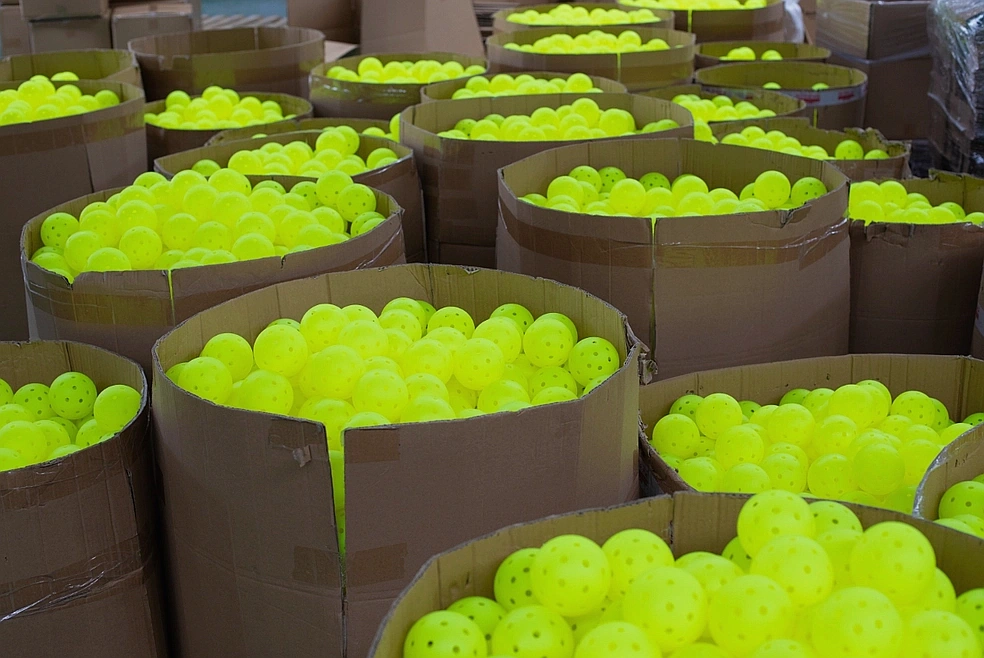
Having bulk pickleballs inventory in stock means the supplier serves as an external warehouse for the facility. This allows managers to respond to sudden events—like hosting a last-minute regional qualifier or a corporate team-building retreat—without the fear of running out of essential equipment. This agility is what separates elite venues from amateur clubs.
Quality Assurance in Bulk Storage
A common concern with bulk inventory is the shelf life and degradation of the polymer. However, professional B2B suppliers utilize climate-controlled warehousing to ensure that the High-Density Polyethylene (HDPE) remains stable. As a ten-year expert, I look for three specific standards in bulk storage:
- ✓ Thermal Stability: Stock must be kept between 60°F and 75°F to prevent the plastic from becoming brittle or overly soft before its first use.
- ✓ FIFO Rotation: Strict “First-In, First-Out” inventory management ensures that no batch sits for more than six months, guaranteeing maximum “pop” upon delivery.
- ✓ Batch Traceability: Every pallet in stock should be linked to a specific production run, allowing for precise quality control if a manufacturing anomaly is detected.
The “Just-in-Case” Strategy for 2026
The global sporting goods market has shifted from “Just-in-Time” to “Just-in-Case.” Following the logistical chaos of the early 2020s, the industry has realized that holding inventory is a form of insurance. For a B2B buyer, a supplier with a massive warehouse of USAP-approved balls is a partner who has already paid the “risk premium” on your behalf.
When you see 1,000,000 balls in a supplier’s inventory, you are seeing guaranteed court hours for the next year. You are seeing a shield against inflation, as stock purchased today is insulated from the rising costs of raw materials and energy tomorrow. This price stability is a significant advantage when setting membership fees or tournament entry costs months in advance.
Technical Specifications of the Ideal In-Stock Ball
Not all bulk inventory is created equal. For professional facilities, the stock must meet the highest performance standards to ensure that rapid replenishment doesn’t come at the cost of quality. In the current market, the gold standard for “ready-to-ship” bulk inventory involves:
Rotational Molding Precision
Unlike injection molding, rotationally molded balls offer uniform wall thickness. This prevents “thin spots” that lead to premature cracking in high-frequency play.
Optic Yellow Consistency
High-volume facilities require consistent color across batches to ensure that balls from different orders can be used interchangeably on the same court without distracting the players.
Aerodynamic Stability
In-stock outdoor models must feature the precision 40-hole pattern, engineered to maintain a true flight path even in wind speeds up to 15 mph.
Regulatory Compliance
Stock must be USAP (USA Pickleball) approved. Facilities cannot risk stocking non-compliant balls that would invalidate tournament results.
Conclusion: Future-Proofing Your Pickleball Business
In the professional world of 2026, the efficiency of your equipment procurement is a direct reflection of your facility’s operational health. By prioritizing bulk pickleballs inventory in stock, you are choosing stability over uncertainty. You are ensuring that every time a player steps onto your court, they are met with a high-performance ball that was delivered on time and within budget.
The days of waiting for containers to cross oceans are ending for smart B2B buyers. The future belongs to those who partner with suppliers capable of delivering thousands of units at a moment’s notice. It is time to eliminate lead-time anxiety and focus on what truly matters: growing the game and providing an elite experience for every player.
B2B Procurement Checklist for Inventory Reliability
- ✓ Warehouse Verification: Does the supplier own the physical stock?
- ✓ Dispatch Time: Is there a 24-48 hour shipping guarantee?
- ✓ Sample Verification: Are current stock samples available for performance testing?
- ✓ Scalable Pricing: Are there fixed price points for bulk tiers despite market fluctuation?
- ✓ Logistics Partners: Do they use reliable LTL (Less-than-Truckload) carriers for bulk orders?
- ✓ Freshness Guarantee: Is there a clear FIFO management policy in place?